Showing posts with label image. Show all posts
Showing posts with label image. Show all posts
Thursday, November 10, 2011
'Smallest fossil' in 3D


Friday, October 28, 2011

Tuesday, October 18, 2011

Wednesday, April 6, 2011
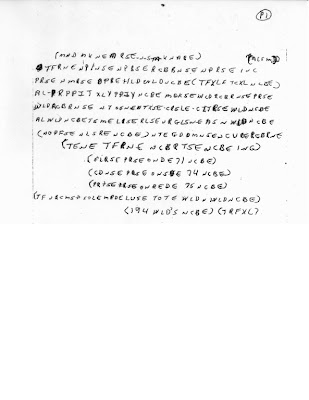
Help Solve an Open Murder Case - alternative methods?
“Maybe someone with a fresh set of eyes might come up with a brilliant new idea.”
Good luck!
I would like to investigate these two texts, like images, because the spatial patterns of the "characters" could give some additional information...but I think, the forensic researchers have already tried this method :)link and source: http://www.fbi.gov/news/stories/2011/march/cryptanalysis_032911
Friday, December 10, 2010
GPS coordinates estimation and camera calibration from solar shadows
Today, I want to present a new research about GPS coordinates estimation. The geolocation calculation of the digital camera was accomplished by using the shadow trajectories. Video sequences were analyzed by this technique in downtown Washington DC and the camera calibration was feasible with the camera footage as well.
I think, this research offers a very useful method in the forensic science!You will find the full paper here: http://cil.cs.ucf.edu/pdf/Junejo_Foroosh_CVIU2010.pdf
 source: http://cil.cs.ucf.edu/
I think, this research offers a very useful method in the forensic science!You will find the full paper here: http://cil.cs.ucf.edu/pdf/Junejo_Foroosh_CVIU2010.pdf
 source: http://cil.cs.ucf.edu/
Sunday, April 25, 2010
Simple, reliable 2.5D photography

More and more people are experimenting with home-made, cheap 3D scanning devices, or something similar:
Saturday, April 3, 2010
Book Flipping Scanning - University of Tokyo
Book flipping scanning system developed at University of Tokyo, great research!

link: http://www.youtube.com/watch?v=tCOXC5PTJj8&feature=player_embedded#

link: http://www.youtube.com/watch?v=tCOXC5PTJj8&feature=player_embedded#
Saturday, March 27, 2010
Reshynthesizer plugin on GIMP

GIMP is an open source software for picture editing.
With this plugin you can remove unnecessary objects on a picture.
Sunday, January 31, 2010
Sunset
"Layers of Earth's atmosphere, brightly colored as the sun sets, are featured in this image taken by the STS-127 crew on the Earth-orbiting space shuttle Endeavour. This image was taken on July 29, 2009, one day before the shuttle landed, completing a 16-day, 6.5-million mile journey.
Image Credit: NASA"

link: http://apod.nasa.gov/apod/archivepix.html
Image Credit: NASA"

link: http://apod.nasa.gov/apod/archivepix.html
Thursday, January 21, 2010
The Landsat Image Mosaic of Antarctica
"The Landsat Image Mosaic of Antarctica (LIMA) is the first true-color, high-spatial-resolution image of the seventh continent. It is constructed from nearly 1100 individually selected Landsat-7 ETM+ scenes. Each image was orthorectified and adjusted for geometric, sensor and illumination variations to a standardized, almost seamless surface reflectance product. Mosaicing to avoid clouds produced a high quality, nearly cloud-free benchmark data set of Antarctica for the International Polar Year from images collected primarily during 1999–2003...."
I like movies, one of my favorite is “The Thing” in the sci-fi/horror category. The story plays on an Antarctic research station. The man can feel on this place the weakness, it is impossible to get help. If I could choose between ice and desert, like extreme places on the earth, I would like to travel to Antarctica. Darkness and nothing (wintertime)…. It is peaceful!
link:
Tuesday, January 12, 2010
1001 Wonders > Europe > Benelux > Netherlands > Rietveld Schröder : map
Nice work! Panorama pictures give us good solutions to create fine visualizations!
http://www.world-heritage-tour.org/europe/benelux/netherlands/rietveld-schroder/map.html
Monday, October 12, 2009

Thursday, October 1, 2009

Thursday, September 17, 2009
Rome built in a day

Okay, this is just uebercool, but I couldn't find any information about the precision of these models.
They look nice, anyway.
Tuesday, September 15, 2009
Permanent cloud and rain over cartoon city

This poor little lakeside town has clouds over it every time...
(I've been checking it for the last few months.)
Hopefully I'll be there in a few weeks, with a bicycle, and a few friends.
(So I'll check that cloud in real life as well.. :)
Saturday, September 12, 2009
Logo II.

However, I'm not satisfied with that... I simply wanted to be it a little bit less linear, but now it looks falling apart. The double border around seems departed now.
Being short of time, I'll only upload the differences in the code.
Now I'm using this line, to determine the difference horizontally:
int diffWidth = Math.min(i, width - i - 1)/2;
This implies, that the gradient will be somewhat smaller horizontally than vertically. (Half of it..)
A small problem with this is, that it doubles width of the vertical borderlines. I'll fix that next week, it's not that cool now.
The other change was, the nonlinearity.
Instead of the modulo function, now I'm using a whole new function to determine, what heights will be grey:
if(isGrey(diffMin)) grey = true;
which is equal to:
grey = isGrey(diffMin);
And the function is:
public static boolean isGrey(int diff)
{
int counter = 6;
int sum = counter;
while(sum <= diff)
{
if(sum == diff)return true;
counter+=4;
sum += counter;
}
return false;
}
Well, the small problem with this is, that it computes every possible height every time. It's not a big deal, since it runs in a few milliseconds, but it would be faster, if I first create a HashSet of integer values, put in the first few values (in this case: 6, 13, 21, 30, 40, 51, 62, ...), and search in that HashSet every time. Maybe I'll do that later.
(However, that would be better even because I could set the heights of the lines manually, without writing an algorithm. For such a small application it would be maybe better.)
Okay, that's it for now, I'll come with a new logo next week.
Tuesday, August 25, 2009
Laser Strike at the Galactic Center

You should check out this one as well!! Interesting idea.
See explanation after clicking on the link:
(Dont worry, no alien invasion! (yet...) )

Monday, August 24, 2009
Gigantic jets

Not really our business, but this is just super-cool: http://www.newscientist.com/article/dn17664-gigantic-jets-blast-electricity-into-upper-atmosphere.html?DCMP=OTC-rss&nsref=online-news
Gigantic jets shoot upwards from thunderclouds and can reach altitudes above 80 kilometres. Now some people managed to measure the electrical discharge from a single gigantic jet, and it turns out: they are as strong as a lightning hitting the ground.
So... a lot of charge is going to heaven... the sky.. the void.
Okay, this is not 'into the void' at all, but still interesting, even after you've been told that the material there is ionised.
You should read the article: there is a hidden world behind the clouds.
Wednesday, August 19, 2009
Nanoscanning
http://www.sciencedaily.com/releases/2009/08/090816171003.htm
"Researchers have created the tiniest laser since its inventien nearly 50 years ago, paving the way for a host of innovations, including superfast computers that use light instead of electrons to process information, advanced sensors and imaging." And so on, and so on...
 Even if I will not work with nanolasers, spasers, or whatever that comes out from the gates of modern science, I'm happy about hearing the news. In time, it will have a positive impact on TLS, laser scanning in the real world. (Well, not that blood cells are not real, but I can't touch them. Scanning a bridge or statue is more of a 'handleable' work, for me at least.)
But: we are using the same 'technology', the same softwares, and we have more or less the same issues. (How will they solve the scanning of a fast moving bacteria, for instance? How can we scan the waving water, or the trees blown by the wind?)
And for the softwares: we are using the same technique for imaging and manipulating the datas. After all, they are just numbers. Scale doesn't matter, we have invented the normal form already. So, if nanolasers mean that the number of engineers working on the field will double, I suppose the efforts for developing softwares will double as well.
It would be nice to see that progress in the near future.
"Researchers have created the tiniest laser since its inventien nearly 50 years ago, paving the way for a host of innovations, including superfast computers that use light instead of electrons to process information, advanced sensors and imaging." And so on, and so on...
Even if I will not work with nanolasers, spasers, or whatever that comes out from the gates of modern science, I'm happy about hearing the news. In time, it will have a positive impact on TLS, laser scanning in the real world. (Well, not that blood cells are not real, but I can't touch them. Scanning a bridge or statue is more of a 'handleable' work, for me at least.)But: we are using the same 'technology', the same softwares, and we have more or less the same issues. (How will they solve the scanning of a fast moving bacteria, for instance? How can we scan the waving water, or the trees blown by the wind?)
And for the softwares: we are using the same technique for imaging and manipulating the datas. After all, they are just numbers. Scale doesn't matter, we have invented the normal form already. So, if nanolasers mean that the number of engineers working on the field will double, I suppose the efforts for developing softwares will double as well.
It would be nice to see that progress in the near future.
Subscribe to:
Posts (Atom)